

For frequent trips with a hard-shell kayak, we recommend a compatible roof rack with padded carriers, cam straps, and bow and stern lines. Then store the boat clean and dry on broad supports that protect its shape. Safe kayak transport keeps the boat attached to your vehicle. Proper kayak storage prevents lasting pressure on the hull.
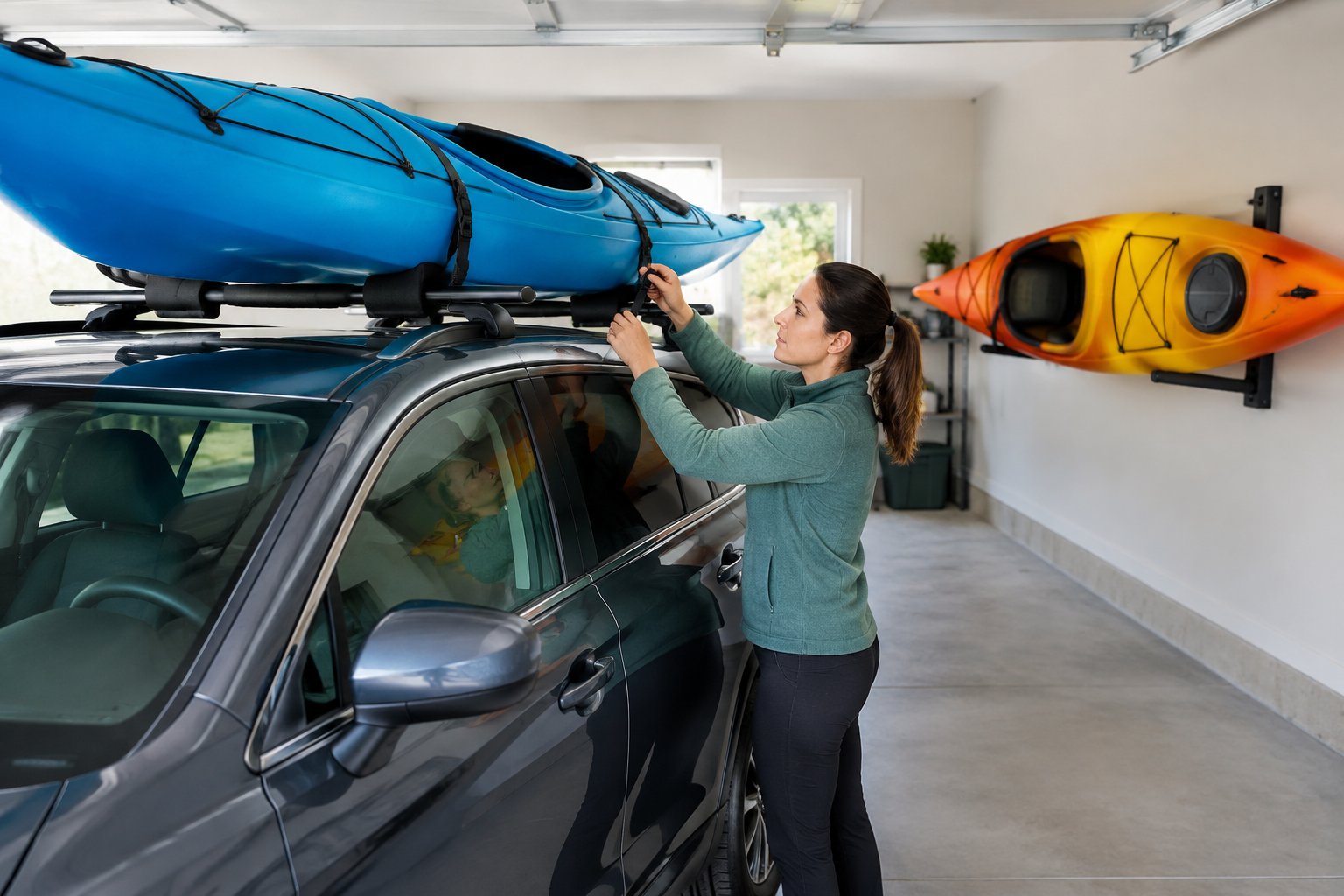
The main risks are easy to overlook: a carrier that exceeds your roof’s weight limit, a strap pulled too tight, or a storage bracket pressing into an unsupported area. Start with the kayak and vehicle manuals, then build a repeatable loading and storage routine around their requirements.
Step 1: Choose a Transport Method That Fits Your Kayak and Vehicle

Choose your transport method before buying a carrier. Use your kayak’s loaded transport weight and your vehicle’s limits to guide your choice. For frequent trips, a fitted roof rack suits many hard-shell boats. A trailer offers a lower loading height for heavy fishing kayaks.
Start by checking these details:
- Kayak dimensions: Confirm its length, width, and weight, including anything that stays attached during travel.
- Vehicle limits: Find the moving roof-load rating in your owner’s manual. Include the weight of crossbars and carriers in that total.
- Lifting access: Check whether you can reach the carrier safely from the ground or a stable step platform.
- Load size: Account for every kayak and carrier when transporting multiple boats.
The best way to transport a kayak must also suit your loading ability. If you struggle to raise the empty boat to roof height, choose lift assistance or a lower transport platform.
For a pickup, support the hull along its length and secure it to rated bed anchors. Check state rules for rear overhang, flags, and lighting before driving.
Step 2: Select and Install a Compatible Roof Rack
A compatible kayak roof rack starts with vehicle-specific mounting hardware and crossbars rated for the complete load. Before selecting the carrier, check fit by your vehicle’s year, make, model, and roof style.
Factory side rails and crossbars serve different purposes. Rails run along the vehicle; crossbars span the roof and provide mounting points for carriers.
When choosing a kayak roof rack, match the carrier to your boat:
- J-cradles hold the kayak on its side and leave room across the roof.
- Saddles support the hull in a horizontal position.
- Stackers carry compatible boats on edge, within the system’s limits.
- Lift-assist carriers reduce the height you must lift the kayak.
Install the feet and crossbars at the specified spacing. Tighten fasteners to the manufacturer’s torque settings. Then attach the kayak rack using its supplied hardware.
Check that clamps close fully and padding contacts the intended support areas. Your setup must stay within every component’s rating, including the vehicle roof, mounting feet, crossbars, and carrier.
Step 3: Move and Load Your Kayak Safely
Use a kayak cart for the approach and ask a helper to load the roof whenever the boat feels awkward or heavy. Prepare the vehicle first so you spend less time holding the kayak in the air.
- Park on level ground and clear the route.
- Remove loose seats, fishing gear, electronics, and other detachable equipment.
- Position the carrier and lay out straps where you can reach them.
- Place the kayak beside the vehicle in the loading direction specified by the carrier.
- Lift together on a spoken count, supporting strong sections of the boat.
- Lower the kayak gently into the carrier and check every contact point.
When selecting a kayak cart, match its capacity and support shape to your hull. Secure the boat to the cart. Use a scupper-style model only when your kayak manufacturer approves that support method.
For solo loading, use a compatible lift-assist system or loading roller. A towel protects paint from light rubbing, but glass, spoilers, and plastic trim require a method that keeps the kayak’s weight off them.
Avoid overhead lifting by carry handles unless the kayak maker expressly approves it.
Step 4: Secure Your Kayak With Straps and End Lines
Use cam straps at the carrier’s main support points, then add bow and stern lines to limit movement at the ends. Hand-tighten cam buckles because excessive strap tension can damage hulls.
For a basic padded-crossbar setup:
- Center the kayak across both supports, following its approved transport orientation.
- Pass a strap over the kayak at the front crossbar.
- Route it underneath the crossbar on both sides, inside the rack feet where the instructions require.
- Feed the free end through the cam buckle and pull it snug.
- Repeat at the rear crossbar.
- Secure the loose strap tails so they cannot reach the road or wheels.
For j-cradles and other carriers, follow their exact strap path. A strap wrapped only around the kayak provides no connection to the vehicle.
Attach bow and stern lines to approved points on the kayak and vehicle. Use suitable hood loops when the vehicle lacks accessible front anchors. Keep lines away from hot or moving parts.
Tighten end lines until slack disappears without pulling the kayak downward. Keep buckles padded or clear of the hull. Avoid ratchet cargo straps, which make it easy to apply excessive tension.
Step 5: Check Your Load Before Driving and During Stops
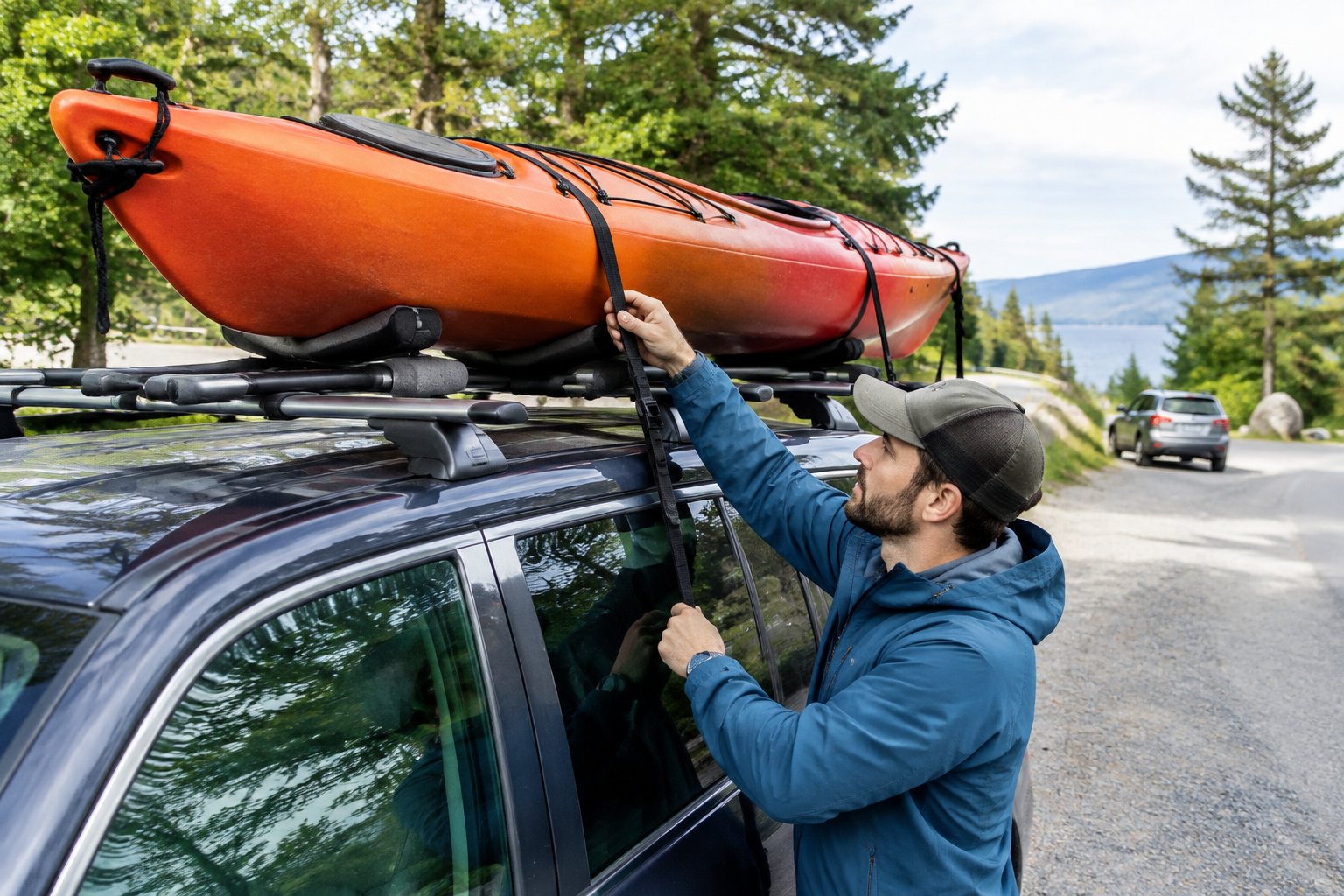
A hands-on load check confirms that the kayak stays seated and every attachment remains secure. Do this before departure, after the initial short stretch of driving, and at each stop.
Grip a solid part of the kayak and gently push it sideways and fore and aft. If it shifts within the carrier, inspect the strap routing and support contact before adding tension.
Include these checks in your kayak equipment inspection:
- Straps have no cuts, severe fraying, or damaged stitching.
- Buckles hold tension and rack clamps remain secure.
- End lines stay clear of tires, exhaust parts, and sharp edges.
- Hatches and any transport-rated cockpit cover are secured.
- The boat clears the rear hatch throughout its travel.
Record your vehicle’s loaded height and check garage entrances or other overhead restrictions. Follow the lowest applicable speed limit set by the vehicle, rack, or carrier manufacturer. Slow down further in wind or on rough roads.
If you hear a new thump or see the bow moving unusually, pull over somewhere safe and inspect the load.
What if You Need to Transport a Kayak Without a Roof Rack?
Use a compatible temporary carrier, a supported truck bed, or a kayak trailer when permanent crossbars are unavailable. Transporting a kayak without a roof rack still requires an approved support system and secure attachment points.
Purpose-built foam-block or soft-rack kits suit only the roofs and loads allowed by their instructions. Before choosing a kayak roof rack for a car without rails, confirm whether your vehicle accepts clamp-on feet, fixed-point mounts, or a temporary system.
For temporary roof systems:
- Clean grit from the roof and support pads.
- Keep the load off glass roof panels unless expressly approved.
- Follow the specified cabin strap route.
- Keep straps clear of airbags and door latches.
- Add the required end lines and check door seals.
Avoid improvised supports with unknown strength or poor resistance to sliding. Even a short journey includes braking and wind loads.
Kayak trailers reduce lifting height and accommodate supported boats within their capacity. Check the tow rating, hitch connection, safety chains, lights, and local registration requirements.
Inflatable kayaks offer another option: pack the dry boat inside the vehicle and secure the bag so it stays in place during sudden braking.
Step 6: Unload, Clean, and Dry Your Kayak Before Storage
Clean and fully dry your kayak before putting it away, especially after saltwater use. Unload on level ground with the same assistance and equipment used for loading.
Keep the main straps attached until you are ready to control the boat. Remove the end lines, release the straps, and lower the kayak onto padded supports.
Rinse the hull with fresh water, paying attention to footwells and areas around fittings. Use mild soap and a soft cloth for stubborn dirt, following the manufacturer’s care instructions.
Open hatches while drying and remove damp seats or fabric accessories. Empty trapped water from accessible compartments. Then inspect the hull for cracks, deep scrapes, or dents.
Inflatable kayaks need extra attention around seams, valves, and removable floors. Dry each accessible surface before folding. Follow the maker’s folding pattern and storage instructions.
If you must pack an inflatable wet at the launch, unpack it for drying as soon as practical. Store clean accessories separately so damp fabric does not sit against the boat.
Step 7: Position and Support Your Kayak on an Indoor Rack or Hoist
Store your kayak indoors on broad, padded supports placed at the locations approved for your boat. Side storage, upside-down storage, and shaped hull cradles each suit particular designs, so follow the boat maker’s instructions.
For kayak storage in a garage or shed, choose a location away from heaters and vehicle traffic. Leave enough space to lift the boat without striking a wall or overhead door.
Install wall brackets into structural framing or suitable masonry anchors. Check the capacity of the complete installation, including fasteners and the wall itself.
Some hulls accept upside-down support on their stiff rails; compatible Hobie kayaks support upside-down storage on padded crossbars. Other designs require shaped supports or different contact points.
A kayak hoist suits garages with usable ceiling space and sound structural mounting points. Use wide straps around the kayak’s body, engage the system’s locking features, and check clearance from garage-door tracks.
Keep storage straps loose enough to avoid squeezing the hull. Never suspend a kayak by its carry handles, deck cords, or grab loops.
Step 8: Protect Your Kayak Outdoors and During Long-Term Storage
Outdoor kayak storage needs shade, elevated supports, and weather protection that allows airflow. Choose a sheltered location where runoff and falling snow cannot collect on the boat.
Use a breathable kayak cover or suspend a weatherproof tarp above the rack. Give the cover enough slope to shed water. Keep it from pressing against the hull under pooled rain or snow.
If you store your kayak outside in winter, drain trapped water before freezing weather. Check the supports and cover after storms, and remove snow buildup before it loads the boat.
For long-term storage:
- Remove batteries and service removable drives as their manuals require.
- Keep openings protected from pests after the interior dries.
- Secure the boat against wind without crushing it.
- Lock it to a fixed anchor through a suitable strong point.
- Inspect periodically for moisture and cover damage.
Apply UV protectant to your kayak only when the product is approved for its material. Maintain shade and cover even when using a protectant. Keep coatings away from surfaces where they affect grip or future repairs.
Make Safe Transport and Supported Storage Your Routine
We recommend repeating the same loading check for every trip and returning the kayak to its approved supports afterward. Keep the vehicle and carrier instructions accessible so you can confirm strap paths or load limits when equipment changes.
Before driving, check attachment points and loose ends. Before storage, let the boat dry fully and confirm that its weight rests evenly on padded supports.
Frequently Asked Questions
Should you leave j-cradles installed between trips?
We recommend leaving j-cradles installed only if their manufacturer permits it and overhead clearance is adequate. Fold adjustable models as instructed, inspect the mounting hardware regularly, and follow removal instructions before entering a car wash.
Can you store wet cam straps in a gear bag?
Dry cam straps before storing them in a closed bag. Rinse away salt or grit, then let the webbing and buckles air-dry. Check for wear before the next trip.
What should you do if your kayak roof rack starts whistling?
Check the rack’s installation instructions for bar orientation, open accessory channels, and required rubber inserts. Pull over safely if the noise starts suddenly, since a loose strap or fitting may also need inspection.
Is vertical kayak storage suitable for every boat?
We recommend vertical kayak storage only when the kayak manufacturer approves it and the stand supports the boat correctly. Secure the upper end against tipping, and follow any limits on duration or end loading.